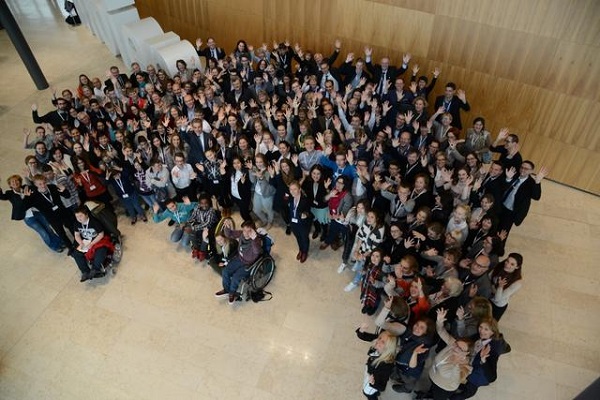
On 15 and 16 October 2015, 250 people gathered to listen to young Europeans, aged between 14 and 16 years old and with and without special educational needs, exchange views and experiences on the implementation of inclusive education.
The event, entitled 'Inclusive Educatuion. Take Action!' was organised by the Ministry of Education, Children and Youth and the European Agency for Special Needs and Inclusive Education as part of the Luxembourg Presidency of the Council of the European Union.
At the end of the hearing, young people from across Europe presented their recommendations to the European and Luxembourg policy makers present, to be reported to the Council of Ministers next month. In assessing the experiences of young people from varied national and schooling backgrounds, the idea is to identify means of reducing existing barriers and move towards a genuine practice of inclusive education.
This form of education will look to improving information for teachers and students concerning specific disabilities and needs; listening to young people concerned and involving them in the implementation of measures to meet their needs; opening of school activities to all students, with and without special needs; adapting the physical environment to specific needs in all areas of school life, looking at accessibility, availability and technical assistance; implementing specific educational offers relating to different disabilities and making better use of assistive technology.
In the context of Luxembourg, pupils with special educational needs (SEN) are predominantly integrated into mainstream education, with less than 1% of children and young people with SEN attending specialised schools. The Ministry stated that in order to give all young people a better future, it intends to further develop this inclusive approach.
To this end, education on offer will be expanded to better take individual needs into account, with the goal of helping every SEN student maximise their personal abilities and facilitate their social integration. In primary education, children who require a lighter specialised framework will be supported by the schools themselves, whilst additional resources will be made at the regional level. Specialised skills centres will also be established to support teachers in their methods and materials, advise parents, and offer ongoing education in the field of specialised pedagogy, based on scientifically proven knowledge.
Existing structure of differentiated education (EDIFF) and multi-professional teams will be assembled to promote cooperation between actors, whilst the collaboration between school and child welfare authorities will be strengthened. For example, the Inclusive Education Commission (CIS) is due to work more closely with the National Children's Office (NCO).
The Ministry has reported that a document summarising the proposals of students and guidelines for inclusive education is due to be developed in the coming weeks, alongside a video posted on the Ministry's website. The Luxembourg Presidency further suggested a greater inclusion of young people at the next European Hearing.
Photos by MENJE