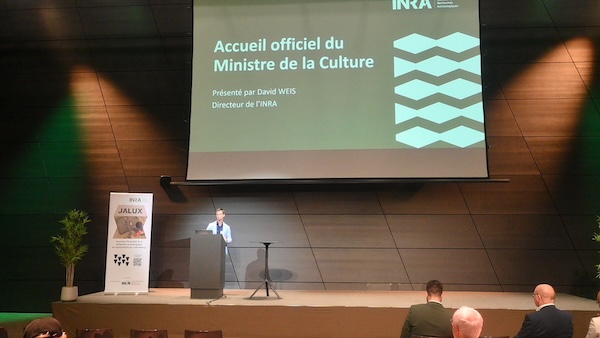
 Davis Weis, INRA President;
Credit: INRA/Shawn Gindt
Davis Weis, INRA President;
Credit: INRA/Shawn Gindt
On Friday 2 October 2026, the National Institute for Archaeological Research (INRA) reported on the fifth Archaeological Research News Days in the Grand Duchy of Luxembourg (JALUX), organised in cooperation with the University of Luxembourg at the Esch-Belval campus.
Luxembourg's Minister of Culture, Eric Thill, opened the event on Thursday 1 October 2026. This marked the second consecutive edition hosted by the University of Luxembourg, reflecting the continued cooperation in archaeological and historical research in the country.
According to the INRA, JALUX brought together 200 participants, including professional archaeologists, researchers, students and volunteers, making it the largest scientific event of its kind dedicated to the cultural heritage of the Greater Region. The INRA was established in 2022.
Strong Political Support for Luxembourg Archaeology
In his opening speech, Minister Thill highlighted the major advances made by Luxembourg in the field of archaeology. The 2022 law provided the country with a modern tool for archaeology and preventive archaeology in particular: the State now covers 100% of the costs of archaeological excavations, including the research that follows the excavations. This coverage guarantees the scientific independence of operations, without impacting economic operators in the housing and development sectors.
“I know that we are not yet where some neighbouring countries are with their long university traditions: Luxembourg therefore has some catching up to do, but that also makes your role all the more important and exciting!”
Minister Thill also recalled the strategy for accessibility to culture that he recently presented to the press, aimed at bringing cultural heritage closer to all audiences: researchers, local history enthusiasts, tourists, young people and people with disabilities, for example. He also welcomed the agreement signed in December 2025 between the INRA and the University of Luxembourg, which has already made it possible to organise numerous conferences, training courses, research projects and internships.
“Archaeology is not limited to a romantic evocation of the past: it aims to understand what we are today and what defines us. It is about confronting myths with facts and studying, in order to better present them, both the good and the less good chapters of human history in our country.”
Two Days of Discoveries, from Prehistory to Modern Times
According to the INRA, the JALUX 2026 programme covered a wide range of presentations, from prehistory to modern times and from local excavations to European projects, as well as environmental issues, new technologies, preventive archaeology, volunteering, the promotion of sites, field museological projects and virtual reality.
Research on Neolithic sites in eastern Luxembourg and the BLACKAXES.DH project, an artificial intelligence-assisted workflow for analysing lithic finds, opened the presentations. These were followed by presentations on Protohistory and the Gallo-Roman period, including the first results of the preventive excavation at Altwies, the ancient settlement of Schandel, the 1st-century tombs uncovered at Heinerscheid-Auf Fring, the “Um Rank” solidi treasure and a digital twin of the Gallo-Roman theatre in Dalheim.
The programme also covered Late Antiquity and the Middle Ages, including new discoveries at the Merovingian necropolis of Audun-le-Tiche, the cemetery of Burmerange, the Trinitarian church in Vianden and the castles of Beaufort and Bettendorf.
Modern Times were represented by the excavations of the former National Library, a 19th-century foundry in Fischbach and the BouLux project, an archaeometallurgical study involving 215 “Austrian” cannonballs discovered in Luxembourg-Bonnevoie, which the INRA described as “unprecedented in Europe”.
Beyond field research, the programme also addressed the promotion of archaeological heritage by the INRA, notably through INRA InSitu, a proposal for a travelling “pop-up” exhibition dedicated to Luxembourg archaeology. An open discussion on the new realities of archaeology in Luxembourg - “Excavating in 6 months – mission (im)possible?” - concluded the two-day event.
The diversity of participants - Luxembourg private operators, partners from the Greater Region (Inrap France, AWaP Belgium and Euro-Metropole of Metz), international researchers, European universities and volunteer associations - reflects the integration of Luxembourg archaeological research into a European scientific network, contributing to the understanding of the country's history and multiple identities, noted the INRA.