On election night in Washington cultural and musical diplomacy – related to Luxembourg – won by a landslide; with little doubt, cultural apathy was slip-sliding away after being banished from the vocabulary.
When smiling faces greet you at the Embassy door and H.E. Ambassador Jean-Louis Wolzfeld is waiting to welcome with open arms, then you know that you are home. Deputy Chief of Mission Olivier Baldauff and Cultural Office Elisabeth Herndler connect with people in a town where relationships matter and diplomats like them nurture these bonds well. With this ambient feeling, it was no wonder that there was standing room only.
Greg Lamy and Paulo Simoes – the Jazz Guitar Duo from Luxembourg – serenaded the audience on the second floor but it must have felt like Cloud 9.
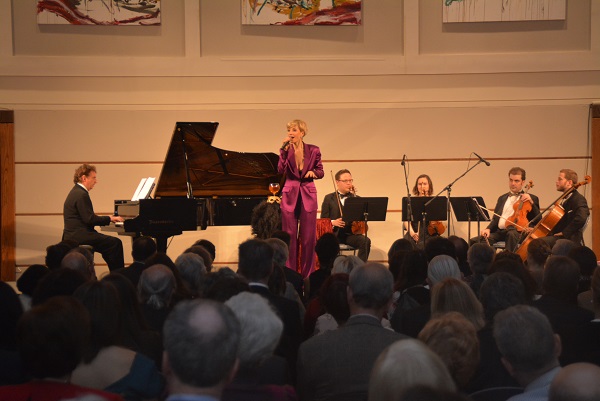
Across town, at the Austrian Embassy, the Embassy Series presented another Luxembourg citizen who brought back memories for the audience about why they were falling in love with Adrienne Haan, international chanteuse. Like a field marshal, she took the audience through the trenches in World War I, dodging explosive projectiles and landing into Berlin, the Weimer cabaret clubs and back into the conflict zones of the decades past. Finally, the diva and the audience emerge with integrity and humanity intact.
Sometimes the words were in English, German, Luxembourgish perhaps, Hebrew and Yiddish. There was no need to Google or translate because you know they were from the heart. And, you could tell that she has a bleeding heart and the colours matched with finely stylish outfit. The audience seemed to relish every moment.
To everything there is a season and a time to every purpose in heaven, Ecclesiastes reminds us.
In his introductory remarks, Embassy Series Founder Jerome Barry used the word ‘reconciliation’ to note that the concert was to mark the 50th anniversary of diplomatic relations between Germany and Israel. Coincidentally, on this day the world learned about the upcoming meeting between the leaders of China and Taiwan – some 66 years after the end of the civil war in that country.
Anne Howard-Tristani, an Embassy Series Board Member, made brief remarks about the Hubert Humphrey Fellows – representing many countries - attending the concert. The Hubert Humphrey programme was established during the presidency of Jimmy Carter in the name of the late US Vice-President Hubert Humphrey who was a lifelong advocate of programmes fostering human rights and international understanding, and earned the nickname “Happy Warrior”. Each of the attending Humphrey Fellows is a mid-career professional on an exciting journey to help further advance international understanding and the ideals that Humphrey embodied.
Following the concert, Daniella Taveau wrote to her friends and supporters “very appreciative of the introduction of the Hubert Humphrey Fellows and all of the diplomats in the room from various countries. It truly was a mini UN.”
Perhaps, Taveau was reminiscing about the memorable recent event at the residence of Ambassador Martin Dahinden of Switzerland which commemorated the 70th Anniversary of the United Nations. For those who have heard Ambassador Dahinden speak at other fora, the musical diplomacy opens up avenues that the Ping Pong diplomacy sometime cannot unclog.
When Barry touches the concept of reconciliation, he probably was thinking of the highly successful concert at the residence of Ambassador Juan Carlos Pinzón of Colombia. There is probably no one more attuned to this subject than Ambassador Pinzón, for Colombia is on the brink of signing a peace agreement with the rebel groups in that country.
By bringing along the Humphrey Fellows to such concerts, Anne Howard-Tristani and Fernanda Katz Ellenberg facilitate on the job training for the emerging leaders of tomorrow.
The Grand Duchy of Luxembourg is currently holding the presidency of the European Union and plays an important role in international affairs. Through the concerted effort of many comes a remarkable outcome - musical diplomacy is winning hands down and pushing apathy into oblivion.
Photo (above) by Morris Simon; (below) by C. Naseer Ahmad