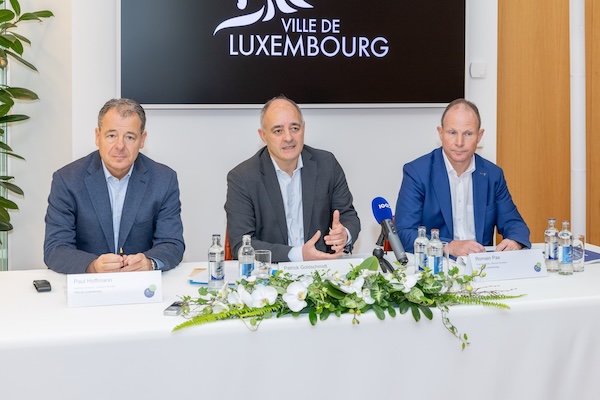
 (L-R) Paul Hoffmann, Mobility Director at the VdL; Patrick Goldschmidt, Alderman responsible for Mobility at the VdL; Romain Pax, Head of the VdL Traffic Department;
Credit: VdL / Jessica Theis
On Tuesday 20 October 2026, Luxembourg City's College of Mayor and Aldermen presented a new active mobility strategy aimed at improving the safety and quality of pedestrian and cycling routes across the capital.
According to the City of Luxembourg (VdL), the strategy forms part of its Mobility Plan 2035, which sets out the city's long-term urban mobility objectives. It includes recommendations for improving existing infrastructure, developing new connections and making travel safer and more convenient for pedestrians and cyclists.
During the press conference, Patrick Goldschmidt, Alderman responsible for Mobility, presented the analyses and surveys carried out during the strategy's development, alongside proposals ranging from short-term improvements to longer-term projects.
He highlighted the close relationship between urban development and mobility in the capital, noting that future changes to the pedestrian and cycling networks would need to take the city's urban development into account.
Minister Goldschmidt also stressed that "mobility in Luxembourg City must be based on harmonious and respectful coexistence among all users of infrastructure and public space".
As outlined in the 2023-2029 College of Mayor and Aldermen's policy declaration, the cycling route network will be extended, optimised, made safer and more coherent, particularly along main routes, within and between neighbourhoods, and in connections with neighbouring municipalities. The plan also involves improving pedestrian routes in public spaces.
The VdL developed the active mobility strategy with municipal departments and consultancy firms Gehl, LSC 360 and TRAMP.
An analysis of VdL's road network identified 21 corridors covering 17.8 km and 30 connection points for potential improvements.
The assessment considered safety, comfort, route directness and attractiveness for cyclists, as well as the quality of public spaces for pedestrians. It also took into account residents' concerns, accident statistics and missing connections.
The findings showed that the existing pedestrian network is already well suited to pedestrian travel.
For cycling infrastructure included in the strategy's target network, consultancy firm Gehl identified five categories:
-
one-way cycle tracks;
-
two-way cycle tracks;
-
cycle streets;
-
mixed traffic;
-
connection points.
Based on these five categories, the project team developed conceptual plans for each of the 21 identified corridors and 30 connection points.
The VdL said it will assess their feasibility, taking into account existing infrastructure, ongoing and future developments, and applicable standards and regulations, with a view to implementation in the short, medium or long term.
For short-term implementation, Gehl proposed the following corridors:
-
Boulevard Franklin D. Roosevelt and Avenue Marie-Thérèse;
-
Avenue Jean-Pierre Pescatore;
-
Boulevard Marcel Cahen and Place de France;
-
Rue des Aubépines (section between Val Sainte-Croix and Route d'Arlon);
-
Rue de Trèves and Rue de Cents;
-
Allée Pierre de Mansfeld;
-
Rue de Merl;
-
Boulevard de Verdun and Boulevard Grande-Duchesse Joséphine-Charlotte.
To continuously improve the evolving active mobility strategy, the VdL plans to evaluate implemented measures according to the principle of "measure, test, refine".
VdL added that regular monitoring of pedestrian and cycling network use will help them analyse travel habits, identify measures that have achieved the intended results and highlight areas where further adjustments may be necessary.