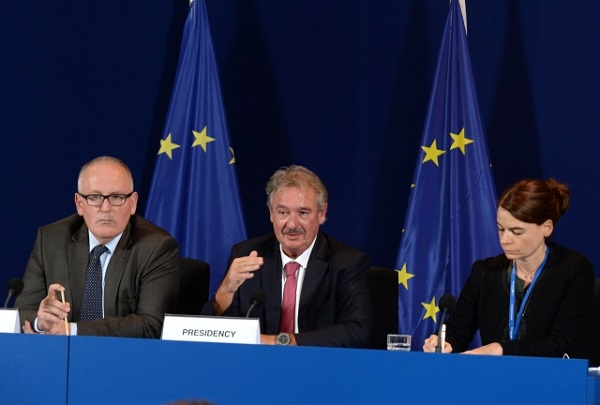
On Tuesday 22 September 2015, a further step was taken in the European refugee relocation process as Luxembourg Minister of Foreign and European Affairs, Minister of Immigration and Asylum, Jean Asselborn, presented the conclusions of the extraordinary meeting of the 'Justice and Home Affairs' Council which he yesterday chaired.
The meeting was convened under the Luxembourg Presidency of the Council of the European Union as a means of allowing ministers to continue discussions of the relocation of 120,000 people seeking international protection within the EU, as was originally proposed by the Commission on 9 September.
At a press conference held after the meeting, Minister Asselborn announced that an agreement had been reached on the emergency relocation of asylum seekers.
"We have reached agreement in Council with a very big majority, a majority which goes beyond the majority required in the Treaties," stated the Minister. "We would have preferred to have adoption by consensus, but we did not manage to achieve that, and it is not for want of trying if I may say so. Some Member States did not join in with this large majority, they pointed out their other, legitimate points of view."
The Minister continued: "Today's decision invlves shared political responsibility. Some people will say today that Europe is divided because the decision was not taken by consensus but we are in an emergency situation, you are all aware of that. The EU is accused of not moving quickly enough in its decisions so we had to adopt this legal decision today on the relocation of 120,000 people, as the Luxembourg Presidency had always planned. If we had not done this, Europe would have been even more divided and its credibility would have been even more undermined. Today's decision reminds us that the European Union is founded on solidarity between and among Member States but also on solidarity to be shown to persons who are in need of protection".
The adopted relocation mechanism involves figures which "which have been accepted by the Member States on a voluntary basis", according to Minister Asselborn, with "quotas no longer in the legal text".
The agreement also accounts for provisions in the event of exceptional circumstances in which a participating Member State would be able to temporarily suspend their refugee responsibility if the country itself was in an emergency situation.
If this was the case, the Commission would examine the request and, if agreed, the Member State would be allowed to forego certain responsibilites provided that the temporary suspension did not exceed 30% of the people to be taken in, or a duration period of more than 12 months.
Photo by European Council (L-R: Frans Timmermans, Vice President of the European Commission; Jean Asselborn, Luxembourg Minister for Foreign and European Affairs, Minister for Immigration and Asylum.)