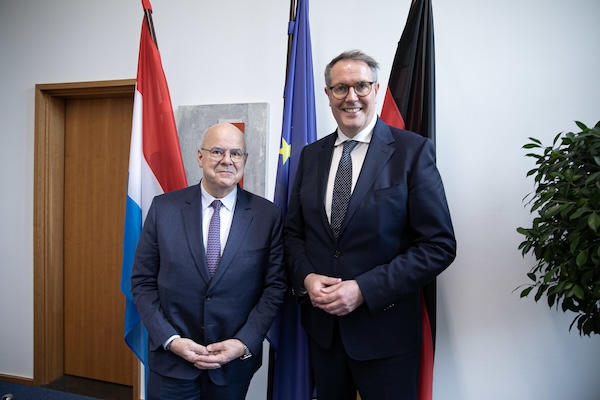
 (L-R) Marc Spautz, Luxembourg's Minister of Labour; Alexander Schweitzer, Germany's Federal Minister of Labour and Social Affairs;
Credit: Bundesministerium für Arbeit und Soziales
From Monday 2 to Wednesday 4 November 2026, Luxembourg’s Minister of Labour Marc Spautz travelled to Berlin in Germany for a working visit, focusing on European employment challenges, social security coordination and cross-border workers' unemployment benefits.
According to Luxembourg's Ministry of Labour, Minister Spautz held discussions with his German counterpart, Federal Minister of Labour and Social Affairs Alexander Schweitzer, and President of the Bundestag Julia Klöckner, among others.
During his meeting with Alexander Schweitzer, the ministers discussed several European challenges in employment and social protection, particularly the coordination of social security systems under the reform of European Regulation No 883/2004. They paid particular attention to unemployment benefits for cross-border workers.
Following the adoption of the reform, Luxembourg will, after a seven-year transitional period, become responsible for supporting cross-border workers who lose their jobs after 22 weeks of uninterrupted employment in the Grand Duchy, as well as paying their unemployment benefits.
To ensure effective support and monitoring of unemployed cross-border workers, Luxembourg will therefore need comprehensive automated cooperation and data exchange with the relevant authorities.
In this context, Minister Spautz received his German counterpart's agreement in principle to closer cooperation between the relevant German authorities and Luxembourg's employment agency ADEM.
"This is an important step in preparing for Luxembourg's future responsibilities," Minister Spautz emphasised.
During his meeting with Julia Klöckner, the discussions focused on the close relations between Luxembourg and Germany and the shared labour market challenges in the Greater Region. According to the ministry, particular attention went to promoting worker mobility and attracting international skilled workers.