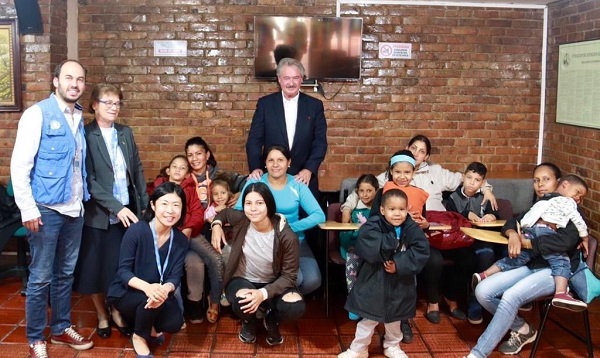
 Jean Asselborn in a migrant assistance centre in Bogota;
Credit: MAEE
Jean Asselborn in a migrant assistance centre in Bogota;
Credit: MAEE
Luxembourg's Minister of Foreign and European Affairs, Jean Asselborn, yesterday travelled to Bogota, the capital of Colombia, for a working visit; he was the first official visitor to be received by Claudia Blum, who was sworn in the previous day as Colombia's new Minister of Foreign Affairs.
During their meeting, Ministers Asselborn and Blum praised the "excellent" bilateral relations between Luxembourg and Colombia, although they agreed that relations could be further developed, particularly in economic matters. In this context, the ministers agreed to strengthen cooperation in the areas of microfinance, air services, satellite communications, vocational training and tourism. In order to deepen economic and trade relations, they also agreed to launch negotiations for a double taxation agreement by 2020.
These discussions also provided an opportunity to review the regional situation in Latin America and to discuss more broadly the relations between the European Union and Colombia. While welcoming the idea of strengthening the EU-Colombia partnership through a new political framework, Minister Asselborn stressed the importance that the EU attaches to the implementation of the Colombian peace agreement.
Regarding social tensions and demonstrations in the streets of Bogota and across the country, Jean Asselborn welcomed the willingness of the Colombian government to engage in a dialogue leading to a "national conversation". Minister Asselborn encouraged the actors involved to "avoid polarisation and confrontation".
The discussions also provided an update on the political situation in Colombia and the peace process. Minister Asselborn assured the Colombian authorities of Luxembourg's continued support for the post-conflict period. He commented: "The Colombian people have endured their lot of suffering and the conclusion of the peace agreement has opened up new opportunities for future generations at all levels, including economic ones".
The EU has supported the peace process from the beginning and committed a total of €585 million for post-conflict support and peacebuilding, including a trust fund involving 19 EU Member States, Luxembourg included, and Chile. In addition, Luxembourg supports transitional justice activities put in place by the International Center for Transitional Justice (ICTJ) in Colombia.
In this context, Minister Asselborn met with the President of the Special Jurisdiction for Peace, Patricia Linares, to review the latest developments related to the transitional justice process. Luxembourg's Foreign Minister took the opportunity to reaffirm Luxembourg's support for this process in Colombia.
During his visit to Bogota, Jean Asselborn also visited a migrant assistance centre supported by the United Nations Refugee Agency (UNHCR) to see the efforts being made on the ground to take in refugees, including those fleeing Venezuela. Minister Asselborn had the chance to talk to refugees who presented the issues they face, including documentation, housing and access to health services. Recalling that Luxembourg is a long-time partner of the UNHCR, Minister Asselborn highlighted the important role of the UN agency in a difficult context like that in Colombia. At present, Colombia has the largest number of refugees and migrants from Venezuela, with more than 1.4 million people.