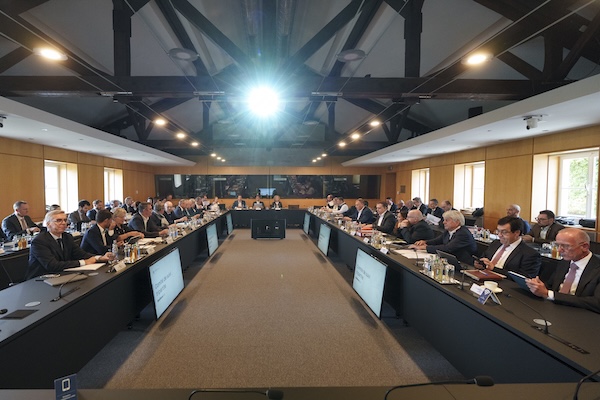
 Group photo;
Credit: SIP / Anthony Dehez
On Tuesday 20 October 2026, the Luxembourg government met with social partners at Senningen Castle to review the implementation of the "Resilienzpak 2026" tripartite agreement, amid rising energy prices and continued economic uncertainty.
According to Luxembourg's Ministry of State, the meeting brought together government representatives, trade unions, the General Confederation of the Civil Service (CGFP), the Union of Luxembourg Enterprises (UEL) and the Chamber of Agriculture.
The agreement, signed on 8 June 2026, introduced measures aimed at supporting purchasing power, businesses and employment in response to the energy crisis. The monitoring committee reviewed their implementation alongside presentations from Luxembourg's national statistics agency STATEC, the National Employment Agency ADEM and Luxembourg’s Ministry of the Economy.
According to the implementation overview, several Resilienzpak measures have already entered into force, including a reduction of five cents per litre in petrol and diesel prices, effective until 31 December 2026. Households also benefit from an additional electricity subsidy of four cents per kilowatt-hour (kWh), bringing total state support for household electricity prices to 11.3 cents per kWh in 2026. Other measures include subsidies of 15 cents per litre for heating oil and 15 cents per cubic metre for natural gas.
During the meeting, the ministry presented the latest developments in Luxembourg's energy supply, reporting that oil prices had risen by 70% over the previous year, as well as highlighted considerable increases in European wholesale gas and electricity prices.
Although residential gas and electricity prices have remained relatively stable due to suppliers' purchasing strategies, the ministry warned that higher wholesale prices could affect households later, while businesses were already experiencing more immediate effects.
STATEC also presented an assessment of the economic situation, noting that Luxembourg's annual inflation rate reached 2.9% in September 2026, following lower-than-expected inflation during the summer. According to the statistics agency, the energy price shock was no longer considered temporary, with effects expected to continue into 2027.
Nevertheless, STATEC's projections indicated that purchasing power would increase across all income groups between 2024 and 2027.
The meeting also included an overview of Luxembourg's labour market, presented by ADEM Director Isabelle Schlesser. Data showed that at the end of September 2026, the country recorded 20,269 registered resident jobseekers, an increase of 7.1% compared with the previous year, while the unemployment rate stood at 6.5%.
STATEC projected employment growth of 1.7% in 2026 and 1.9% in 2027, remaining below Luxembourg's longer-term average.
Meanwhile, the implementation overview confirmed that several measures remain in the legislative process, including a structural 3.8% increase in the social minimum wage from 1 January 2027 and an increase in the minimum wage tax credit from €81 to €179, followed by a further rise to €200 from July 2027.
Other planned measures include adjustments to income tax brackets and the introduction of social leasing from January 2027.